


On this page
React Native powers apps serving over 2 billion active users across Meta's products alone. 18,800+ production companies actively use it for large-scale applications. It holds 35-42% of the cross-platform market, and approximately 14.85% of the top 500 US apps by revenue are built with it.
But aggregate stats don't settle architectural debates. Specific production results from specific companies do. Each app below proves a specific claim about React Native that matters for your hiring and technology decisions. Not "React Native is great" generalities, but documented results: how much code they share, what performance they achieve, how many engineers they need, and what they learn along the way.
1. Shopify

Shopify is the e-commerce platform powering millions of online stores. Shop, Shop Pay, Shopify POS, and the merchant admin app all run on React Native.
Shopify completed full migration of its flagship app to React Native by 2025, achieving 86% code unification across iOS and Android. They eliminated 1.8 million lines of redundant code. Crash-free sessions sit above 99.9%. Screen load times are under 500ms at P75.
React Native handles enterprise-scale migration. Shopify didn't build a new app from scratch. They migrated hundreds of existing screens, 40+ native modules, and deep first-party integrations from native codebases. Their developers reported feeling twice as productive after the migration. Engineers now work across web and mobile, and feature parity between iOS and Android has become automatic instead of a coordination burden.
If your app has an existing native codebase and you're considering a migration, the developer you hire needs experience with New Architecture migration, not just greenfield React Native skills. Shopify's migration team contributed upstream fixes to React Native core and built FlashList, which now has over 2 million monthly downloads. That's the caliber of engineering required for a complex migration.
2. Instagram

Instagram is Meta's photo- and video-sharing platform with 2+ billion monthly active users. Instagram didn't rebuild in React Native. They adopted it incrementally, starting with the Push Notifications view as a test. They migrated key product screens separately while the rest of the app remained native. Once integrated, 85% to 99% of code was shared between Android and iOS, depending on the product feature, and the team achieved significantly higher iteration speed using Live Reload and Hot Reloading, which eliminated compile-install cycles.
You don't have to go all-in. React Native works as a brownfield solution inside existing native codebases. Meta's approach was surgical: migrate screens where cross-platform code sharing delivered the most value and keep native code where platform-specific behavior mattered. This hybrid model is the most pragmatic path to adoption for large, existing apps.
If your codebase is already native and you want to adopt React Native incrementally, your developer needs experience with React Native's brownfield integration. They should understand how React Native screens coexist with Swift/Kotlin screens in the same app, how navigation bridges work, and how to share state between the two layers. This is a specialized skill set. See our New Architecture guide for what that looks like technically.
3. Discord
Discord is used by 200+ million monthly active users. Its iOS app used React Native from the start. The Android app was originally written in native Kotlin, but Discord migrated it to React Native in 2022 after Hermes addressed its earlier performance concerns. The two apps now share 98% of code. The iOS app maintains 99.9% crash-free sessions and a 4.8-star App Store rating. React Native eliminated the need for specialized native mobile developers, allowing Discord to leverage its existing pool of JavaScript and React web engineers for mobile work.
React Native handles real-time communication. Voice over IP, live typing indicators, message synchronization, presence status, and server switching all work at the latency users expect. Discord's use case is one of the most demanding in mobile development: real-time data sync across thousands of concurrent servers, each with its own message stream, voice channel, and member list. If React Native can handle this, it can handle your data feed.
Real-time apps require developers who understand WebSocket connections, optimistic UI updates, and efficient list rendering for rapidly changing data. The standard CRUD-focused React Native developer may struggle with the concurrency and performance patterns required by real-time features.
4. Microsoft Teams
Microsoft has 320+ million monthly active users. Teams mobile runs on React Native across iOS and Android. Microsoft also uses React Native for portions of Office mobile, Outlook, and Xbox Game Pass.
You can achieve enterprise security, compliance, and scale with React Native. Microsoft Teams supports SSO via Azure Active Directory, enterprise data loss prevention policies, Intune mobile device management, and SOC 2, HIPAA, and FedRAMP compliance. If the world's most security-conscious enterprise customers trust a React Native app with their corporate data, the framework's security posture is validated.
Enterprise app developers need experience with SSO integration, MDM compatibility, and compliance frameworks. These aren't standard React Native skills. If your app serves enterprise customers, look for developers who understand RBAC, data encryption policies, and app-level VPN configuration. See our fintech hiring guide for similar compliance-specific hiring guidance.
5. Coinbase
Coinbase is a cryptocurrency exchange and wallet with 110+ million verified users. They rewrote its Android app in React Native and saw an 80% improvement in funnel performance. The app handles real-time price data, trading execution, and portfolio management across volatile markets.
React Native for fintech security and performance needs. Coinbase is handling billions in daily trading volume through an app that must be resilient against sophisticated attacks, compliant with SEC and FinCEN regulations, and fast enough that a 500ms trade delay would cost users real money. The fact that they decided to rewrite in React Native, rather than just maintain a legacy app, suggests that the framework's security architecture is good enough for financial-grade apps.
Fintech React Native developers need security skills beyond the standard mobile developer toolkit: encrypted storage, certificate pinning, biometric gating, and compliance-aware architecture. See our fintech hiring guide for the specific skills and interview questions.
6. Pinterest

Pinterest has 480+ million monthly active users. They use React Native for their mobile apps, rendering millions of image pins in an infinite-scroll feed across diverse device types and network conditions.
Performance for image-heavy, scroll-intensive UIs. Pinterest's core experience is an infinite masonry grid of images that loads progressively as users scroll. This is one of the hardest performance challenges in mobile development: lazy-loading images, recycling list views, maintaining smooth 60fps scrolling on mid-range devices, and handling memory pressure from hundreds of decoded images. React Native with FlashList and proper image caching handles this at Pinterest's scale.
Image-heavy apps need developers who understand image optimization (WebP format, progressive loading, CDN caching), memory management (releasing decoded images as they scroll off-screen), and list virtualization (FlashList with a proper estimatedItemSize). These are performance skills that separate senior developers from mid-level developers.
7. Bloomberg

Bloomberg is a financial data and media platform used by financial professionals worldwide. Bloomberg's mobile app provides real-time market data, complex financial charts, news feeds, and watchlists through React Native.
Data-dense, real-time interfaces work in React Native. Bloomberg's app renders multi-axis financial charts that update every second with live market data. The information density per screen is among the highest of any mobile app: prices, charts, news, alerts, watchlists, and portfolio data all on screens that must remain responsive during market volatility.
Data visualization in React Native requires experience with charting libraries (react-native-charts-wrapper, Victory Native, or custom D3 integration), WebSocket data streams, and efficient re-rendering strategies to prevent charts from freezing when hundreds of data points update simultaneously.
8. Tesla
Tesla’s companion app for controlling vehicles, monitoring charging, and managing vehicle settings. The Tesla app uses React Native to control physical car functions: lock/unlock, climate control, location tracking, charging management, and Summon (remote vehicle movement).
React Native can interface with physical hardware through native modules. The Tesla app communicates with vehicles over cellular networks and Bluetooth, controlling real-world actuators (locks, HVAC, motors) from a JavaScript-driven UI. This pushes React Native beyond typical CRUD applications into IoT and hardware control territory.
Hardware-interfacing apps need developers who can write native modules in Swift and Kotlin, understand Bluetooth communication protocols, and handle the reliability requirements of controlling physical devices (a failed API call that unlocks your car is a different severity level than a failed API call that doesn't load a profile picture).
9. Walmart
Walmart uses React Native for its mobile commerce experience, serving tens of millions of active users and maintaining product catalogs with millions of SKUs. 95% of the codebase is shared between iOS and Android. Walmart reported that React Native delivered performance nearly identical to that of native apps, with extremely smooth animations, even in its product grid and checkout flows. The switch allowed engineers' skills and experience to be leveraged across the entire organization rather than being siloed in platform-specific teams.
E-commerce at the highest volume works in React Native. Walmart's app handles product search across millions of items, complex cart logic with store-specific inventory, real-time pricing, multiple payment methods, and curbside pickup coordination. The performance requirements are strict: any lag in the shopping experience directly correlates with cart abandonment and lost revenue.
E-commerce developers need experience with payment gateway integration (Stripe, Braintree), cart state management (handling concurrent modifications, inventory checks, pricing updates), and search performance (debounced queries, cached results, progressive filtering). These are domain-specific skills in addition to React Native fundamentals.
10. Shopify POS

Shopify is used by 1000s of merchants on iPads and mobile devices in retail stores. They tested their POS app on low-power Android hardware and confirmed React Native runs reliably on devices with lower CPU thresholds. Code sharing between iOS and Android exceeded 95% in the Arrive app and 99% in the Compass app.
React Native performs on budget devices, not just flagships. The POS use case demands reliability on hardware that merchants buy for price, not performance: mid-range iPads, budget Android tablets, and older devices that aren't replaced annually. If React Native stutters during a checkout, the merchant loses a sale. Shopify validated that Hermes and the New Architecture deliver the performance needed on constrained hardware.
If your app targets emerging markets, field workers, or retail environments where users don't have flagship phones, your developer needs experience profiling on mid-range and budget devices. Testing exclusively on a MacBook simulator or an iPhone 15 Pro doesn't tell you how the app performs where most of your users actually are.
11. Uber Eats
Uber Eats connects 1000s of restaurants, delivery drivers, and customers. Unlike the standard Uber app (two parties: driver and rider), Uber Eats involves three parties, which requires an additional restaurant dashboard. The original dashboard was built for the web, limiting native device features like sound notifications. The team rebuilt it in React Native, leveraging their existing React web expertise. Although React Native constitutes a small part of the overall Uber Eats stack, the development team has been positive about its ability to meet the marketplace's growing needs.
React Native handles multi-stakeholder business logic. The restaurant dashboard manages real-time order notifications (with native sound alerts that the web version couldn't deliver), order acceptance workflows, menu management, and live delivery tracking. Building it with React Native meant the team could go mobile using the same technologies they used for the web, with no ramp-up to Swift or Kotlin.
Marketplace and multi-sided platform apps need developers who understand real-time notification systems, multi-role UI (different screens for different user types), and the complexity of coordinating state across multiple parties in a single transaction.
12. Wix
No-code website builder powering millions of websites. The Wix mobile app lets users build, edit, and manage their websites from their phone. Wix was one of the earliest adopters, diving into React Native around 2015 when it was still experimental. Today, the Wix app is one of the largest React Native applications in the world, with more than 650 different screens. iOS and Android versions are released twice per week. The company chose React Native because they were already using React for the web and wanted to save time by developing both platforms simultaneously.
React Native scales to massive apps. Over 650 screens, which is more than most apps ever get to. The twice-a-week releases on both platforms demonstrate that the development workflow supports enterprise-grade release cadence. This shatters the myth that React Native is only for small/simple apps.
Large-scale React Native apps need developers who understand code organization at scale: monorepo tooling, feature-module boundaries, shared component libraries, and release-management automation. A developer who has built a 20-screen app doesn't automatically know how to organize a 200-screen codebase.
13. Facebook Ads
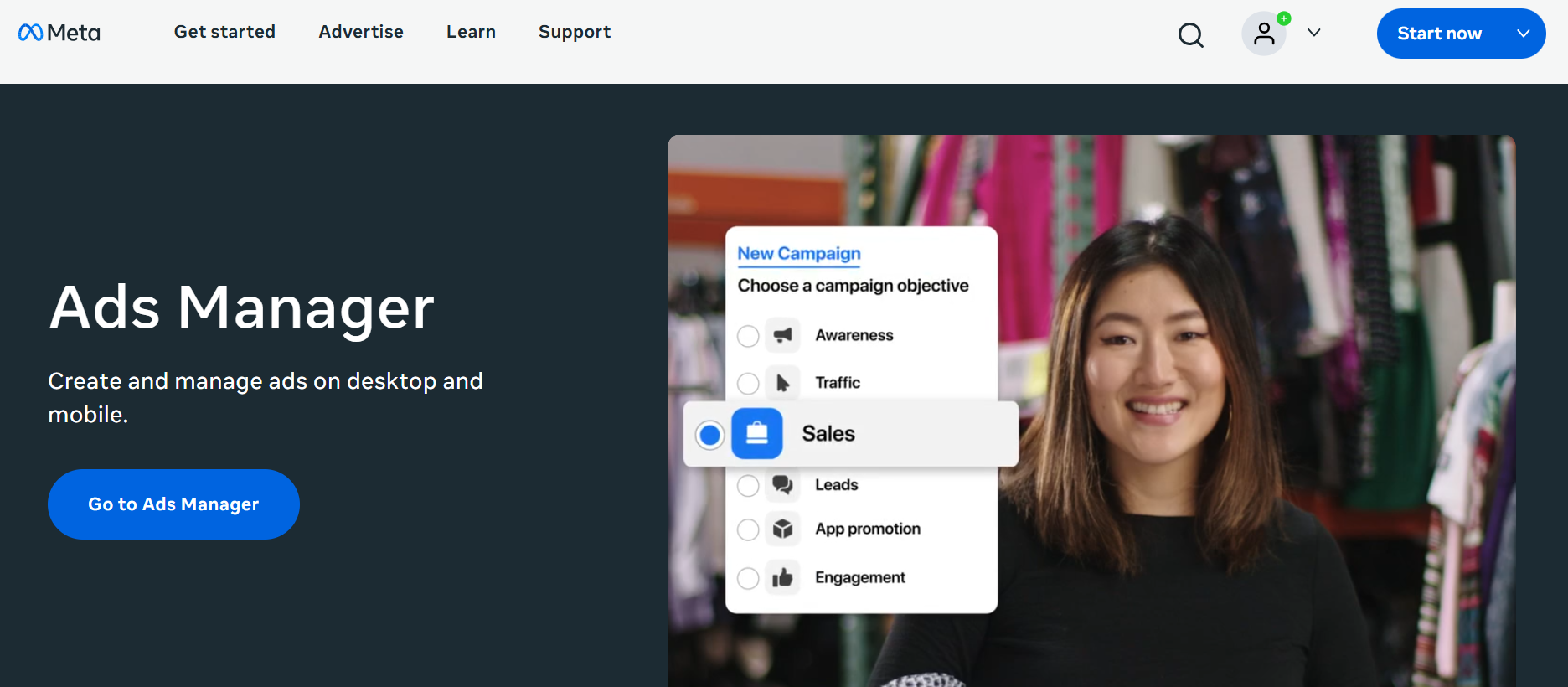
Meta's ad management platform is the first fully React Native cross-platform app the company has built. Facebook Ads handles complex business logic, including variations in ad formats, time zones, date formats, currencies, and currency conventions across dozens of markets. A large portion of this logic was already written in JavaScript, making React Native a natural fit. Numerous components built alongside the Ads app have been reused by other development teams across Meta.
React Native excels at data-heavy business applications with complex logic. The Ads Manager isn't a simple CRUD app. It processes enormous volumes of data, displays it in multiple visualization formats, and handles region-specific business rules that vary by market. If React Native can handle the business logic complexity that drives Meta's $130+ billion in advertising revenue, it can handle your business application.
Apps with complex business logic (SaaS dashboards, admin panels, analytics tools, CRM interfaces) need developers who can organize data flow cleanly. The developer should understand how to separate business rules from UI, handle internationalization (i18n) for multi-market products, and manage state across deeply nested screens.
The Warning: When React Native Doesn't Fit
Airbnb: They Left, and Here's What They Learned
Not every React Native story ends with "and they lived happily ever after." Airbnb adopted React Native for its mobile apps and initially saw strong results. The code was highly reusable, and React made it very easy to refactor. The framework boosted user engagement by 40%.
But in 2018, Airbnb announced they were moving away from React Native to fully native development. The reasons were specific:
Integration with their complex existing native codebase created friction. The cost of brownfield integration was high.
Engineers new to React struggled with state management concepts, creating an ongoing training burden.
Bridging between React Native and native layers introduced debugging complexity that slowed down some teams.
Airbnb described the overall experience as positive. They acknowledged React Native's advantages and even released the Epoxy library for Android, borrowing concepts like declarative syntax and component tree diffing from React Native. Their departure was driven by organizational complexity, not framework capability.
What this means for hiring: If your app has a large existing native codebase with deep platform-specific integrations, brownfield adoption requires careful planning and experienced developers. The developer you hire must understand the cost of bridging between React Native and native layers. For greenfield projects (starting from scratch), Airbnb's concerns don't apply. For brownfield, ask candidates specifically about their experience integrating React Native into existing native apps.
What All 13 Apps Prove Together
| Claim | Apps That Prove It |
|---|---|
| React Native scales to billions of users | Instagram (2B+ MAU), Facebook, Microsoft Teams (320M MAU) |
| React Native handles real-time communication | Discord (200M MAU, 98% code sharing, 99.9% crash-free), Bloomberg (live market data) |
| React Native meets enterprise compliance | Microsoft Teams (SOC 2, HIPAA, FedRAMP), Coinbase (SEC, FinCEN) |
| React Native replaces native at scale | Shopify (86% sharing, 99.9% crash-free, 1.8M lines eliminated, 2x developer productivity) |
| React Native works for fintech | Coinbase (110M users, 80% funnel improvement), Bloomberg |
| React Native handles image-heavy UIs | Pinterest (480M MAU, infinite masonry grid) |
| React Native controls physical hardware | Tesla (vehicle lock, HVAC, Summon, charging) |
| React Native runs on budget devices | Shopify POS (low-CPU Android), Flipkart (budget Android market in India) |
| React Native enables 90%+ code sharing | Discord (98%), Walmart (95%), Instagram (85-99%), Shopify Arrive (95%), Shopify Compass (99%) |
| React Native scales to 650+ screens | Wix (twice-weekly releases on both platforms) |
| React Native handles complex business logic | Facebook Ads (multi-market currencies, formats, time zones) |
| React Native powers multi-party marketplaces | Uber Eats (restaurants + drivers + customers) |
| React Native works for emerging market e-commerce | Flipkart (India's largest platform, OTA updates for slow-update markets) |
| React Native isn't always the right choice | Airbnb (left due to brownfield integration complexity, not framework limitations) |
What to Do Next
These apps prove what React Native can handle. The next step is finding a developer who can build at this level for your product.
For the full hiring process, see our step-by-step hiring guide. For understanding costs, see our developer cost guide. For evaluating developer skills, see our must-have skills guide.
At Hire React Native Developers, every developer on our platform has shipped production React Native apps. Vetted senior developer in your team within 5 days, 2-week risk-free trial. Hire a React Native Developer →
Ready to build? dedicated React Native developers through our vetted network.


